Written by Lolitaire Moyo-Healey. M.Ost DO, UKIHCA-RHC for BonVie Medical Aid scheme
You wake up, drive to work, sit at your desk for eight hours, drive home, and settle onto the sofa for the evening. Sound familiar? For many working Zimbabweans, especially those in office-based roles, this is a very ordinary day. But research increasingly shows that this pattern is doing quiet, cumulative damage to your body, and that your weekly gym session may not be enough to undo it.
The Scale of the Problem
The problem is that prolonged sitting is actually a measurable health risk. A large, long-term study over 13 years showed that compared to people who move around, those who mainly sit at work have a 16% higher risk of death (from any cause) and a 34% higher risk of dying from heart disease. This was true even for those who were otherwise healthy, smoked less, or were not overweight [1].
Prolonged sitting significantly raises the risk of heart disease and obesity even in young, physically active adults, and standard exercise guidelines are insufficient to offset the harm [2]. In other words, going to the gym three times a week does not cancel out sitting for nine hours a day.
What is Happening in Your Body
Your blood sugar spikes – When you sit for long stretches, your muscles become inactive and stop drawing glucose out of your bloodstream efficiently[3].
Your heart works harder over time – Inactivity slows circulation and means your heart doesn’t have to work as hard, which actually weakens your cardiovascular system [1].
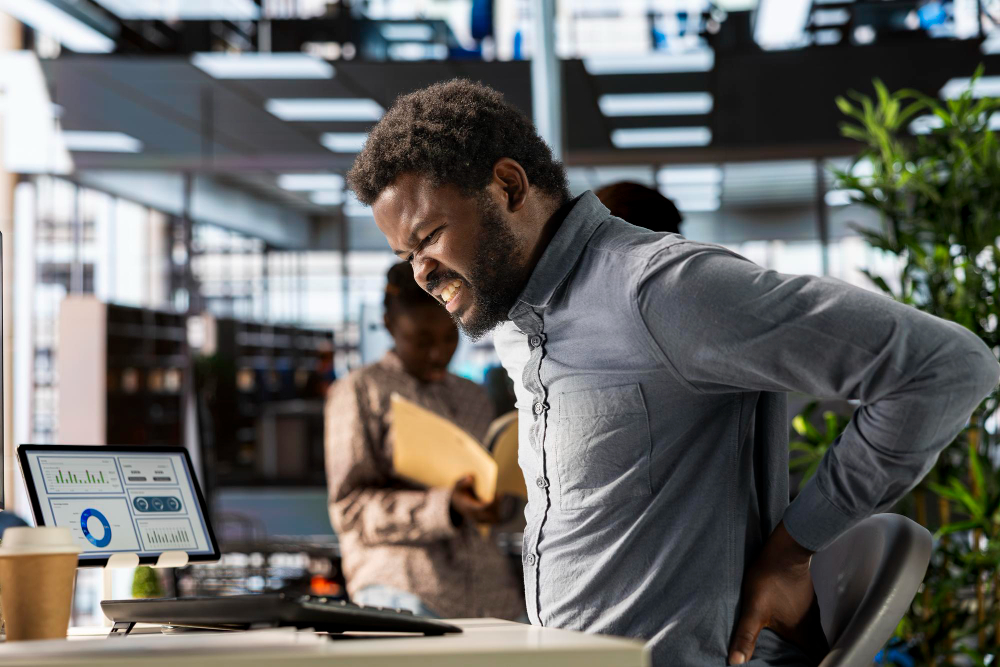
Your back takes strain – The muscles supporting your back are under up to 90% more pressure when you are seated versus when you are standing [4]. Prolonged sitting reduces blood flow and hydration to the vertebral discs in your spine, which over time contributes to disc degeneration, herniation, and chronic lower back pain [5]. Sedentary behaviour is a significant risk factor for low back pain in adults [6].
Your concentration suffers – After just two hours of seated computer work, creative problem-solving errors increase and overall mental state deteriorates [7]. Prolonged sitting has also been linked to poorer executive function (ability to plan, focus, and make decisions), attention, and memory, all of which matter for work [8].
Why “Just Exercise More” Is Not the Full Answer
It is a reasonable instinct that if sitting is harmful, surely working out compensates for it. However it’s been proven that meeting recommended exercise guidelines does not fully protect you if you remain sedentary for most of your waking hours [1][2]. The problem is the long hours of sitting and the pattern of your day, not just the total minutes of movement.


What Actually Works
1. Alternating sitting and standing – Standing desks have become popular, but you do not need one to start standing for part of your working day. Even just finding a higher surface you can work on or take a call on makes a difference. The best you can do is alternate between sitting and standing, combined with brief walks. This is significantly more effective than standing alone [9].
2. Short walks after meals – Standing or walking for 15 to 30 minutes after a meal has a strong effect on blood sugar control [9]. If you have a lunch break, use part of it to move around and walk.
3. Reducing total sitting time – Replacing even 30 minutes of sedentary time per day with light activity like walking or standing improves key markers including BMI and cholesterol levels [3].
Practical Steps You Can Start Today
- Set a movement reminder on your phone for every 30 minutes during the workday
- Take calls standing or walking where possible
- Walk to a colleague’s desk rather than sending a message
- Use your lunch break to walk, even for 10 minutes
- Park further away or get off transport one stop early
Conclusion
Small, consistent interruptions to your sitting time matter more than a single long burst of exercise. The conditions most strongly linked to prolonged sitting (cardiovascular disease, type 2 diabetes, and chronic musculoskeletal pain) are among the most disruptive to your life. Breaking up long periods of sitting costs nothing and prevention is always better.
References
- Gao W, et al. Occupational Sitting Time, Leisure Physical Activity, and All-Cause and Cardiovascular Disease Mortality. *JAMA Network Open.* 2024;7(1):e2350680. https://pmc.ncbi.nlm.nih.gov/articles/PMC10799265/
- University of California, Riverside. Too much sitting hurts even young, active people. *UCR News.* December 2024. https://news.ucr.edu/articles/2024/12/04/too-much-sitting-hurts-even-young-active-people
- Diaz K, et al. Breaking up prolonged sitting with light walking: findings from *Medicine & Science in Sports & Exercise.* 2023. Reported via HF Chronicle, April 2024. https://www.hfchronicle.com/2024/04/11/45349/
- Cornell University Department of Ergonomics. Cited in: Sedentarism and its effects on the spine. *SpineHealth.org.* https://spinehealth.org/article/sedentarism-and-its-effects-on-the-spine/
- Atlas Pain Specialists. How a sedentary lifestyle is fuelling your back pain. 2024. https://atlaspainspecialists.com/sedentary-lifestyle-and-back-pain/
- Alizadeh Sani M, et al. Association between sedentary behavior and low back pain: a systematic review and meta-analysis. *PMC.* 2022. https://pmc.nbi.nlm.nih.gov/articles/PMC8767074/
- Thorp AA, et al. The short-term musculoskeletal and cognitive effects of prolonged sitting during office computer work. *PMC.* 2018. https://www.ncbi.nlm.nih.gov/pmc/articles/PMC6122014/
- Loh R, et al. Does breaking up prolonged sitting improve cognitive functions in sedentary adults? *PMC.* 2021. https://www.ncbi.nlm.nih.gov/pmc/articles/PMC7955618/
- Healy GN, Eakin EG, Winkler EA, Hadgraft N, Dunstan DW, Gilson ND, Goode AD. Assessing the Feasibility and Pre-Post Impact Evaluation of the Beta (Test) Version of the BeUpstanding Champion Toolkit in Reducing Workplace Sitting: Pilot Study. JMIR Form Res. 2018 Aug 28;2(2):e17. doi: 10.2196/formative.9343. PMID: 30684420; PMCID: PMC6334681.
Author

Lolitaire Moyo-Healey
M.Ost DO, UKIHCA-RHC, Founder, Registered Osteopath, Mindfulness Practitioner, Accredited Health + Life Coach